MedQuire
Making medication information understandable for everyone through AI.
Project Summary
Category
HealthTech
Project Type
Product Design & Engineering Bootcamp Capstone Project
Role
Product Engineer Team Lead
Platform
Mobile Application
Status
MVP
Team
Team-Based Project
Live Application
Responsibilities
- Led the product design process from discovery to solution definition.
- Defined the product direction and MVP scope.
- Facilitated collaboration within the design team.
- Conducted user research and competitor analysis.
- Designed user flows, wireframes, and high-fidelity interfaces.
- Worked closely with the team throughout the product development lifecycle.
Tools
- Figma
- React Native
- Expo
- Antigravity
- Firebase
- DeepSeek API
- OpenFDA API
- ChatGPT
- Railway

The Story
MedQuire is an AI-powered medication companion designed to bridge the gap between complex medical language and everyday understanding.
Many patients leave pharmacies relying solely on verbal explanations because prescription labels, medication guides, and drug information are often written using technical terminology that can be difficult to understand.
MedQuire simplifies medication information into clear, everyday language while helping users better understand drug interactions, manage frequently used medications, and ask follow-up questions through an AI-powered assistant.
The product was developed as my team's capstone project during a Product Design & Engineering Bootcamp, where I served as the Product Design Team Lead.
Research & Discovery
Before exploring solutions, we focused on understanding how people currently interact with medication information.
Our research combined user conversations, personal observations, desk research, and competitor analysis.
Research Activities
- Conversations with patients who regularly use prescription and over-the-counter medications.
- Personal observations and discussions with friends and family.
- Review of FDA medication resources and public drug information.
- Analysis of existing AI-powered healthcare applications.
Rather than relying on assumptions, we wanted our product decisions to reflect real user needs.
Key Insights
Several clear patterns emerged throughout our research.
Patients rely heavily on verbal explanations.
Many users trusted their pharmacists but admitted they rarely understood medication leaflets on their own.
Medical terminology creates unnecessary barriers.
Users often described medication information as overwhelming, technical, or intimidating.
People wanted clarity—not more information.
Most users weren't looking for additional medical resources.
They simply wanted existing information explained in language they could understand.
Medication literacy affects everyone.
Whether managing chronic illnesses, taking short-term prescriptions, or caring for family members, nearly everyone encounters medication information that can be difficult to interpret.
Target Users
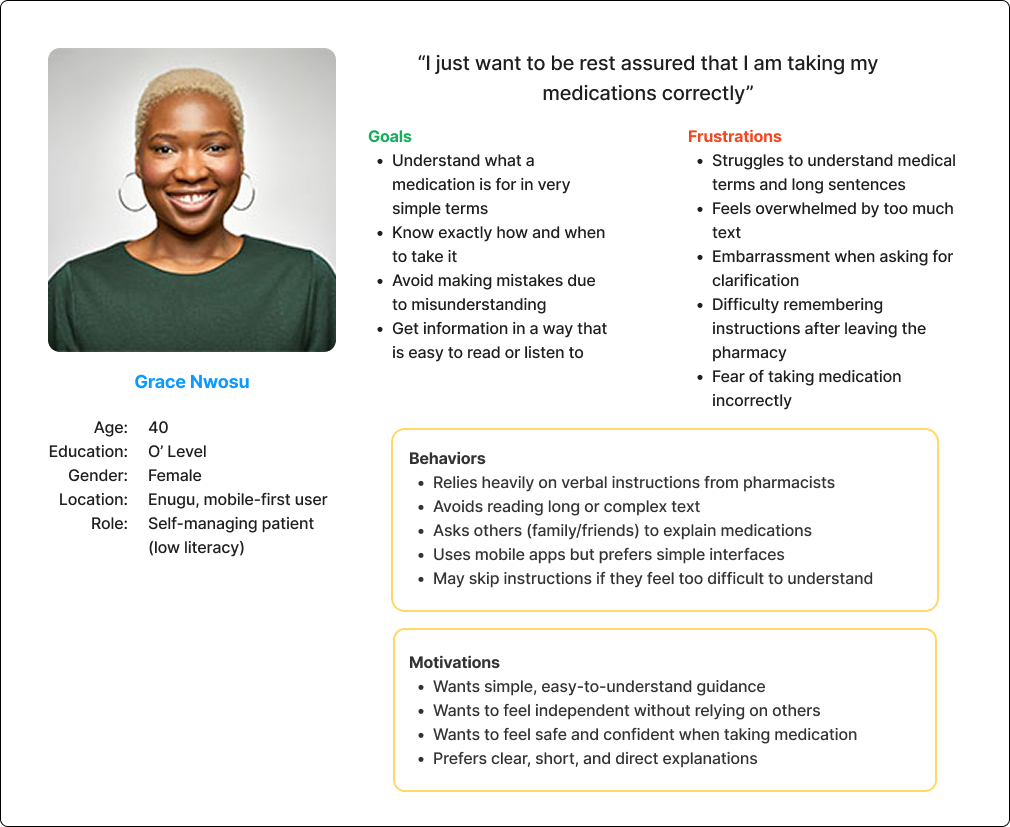
Primary audiences include:
- Adults managing prescription medications.
- Older adults taking multiple medications.
- Individuals living with chronic illnesses.
- Patients with limited health literacy.
- First-time prescription users.
Secondary audiences include:
- Parents.
- Caregivers.
- Family members supporting loved ones.
- Anyone seeking a simpler explanation of medication information.
Although these groups have different needs, they all share one common challenge:
Understanding medication information shouldn't require medical training.
Competitor Analysis
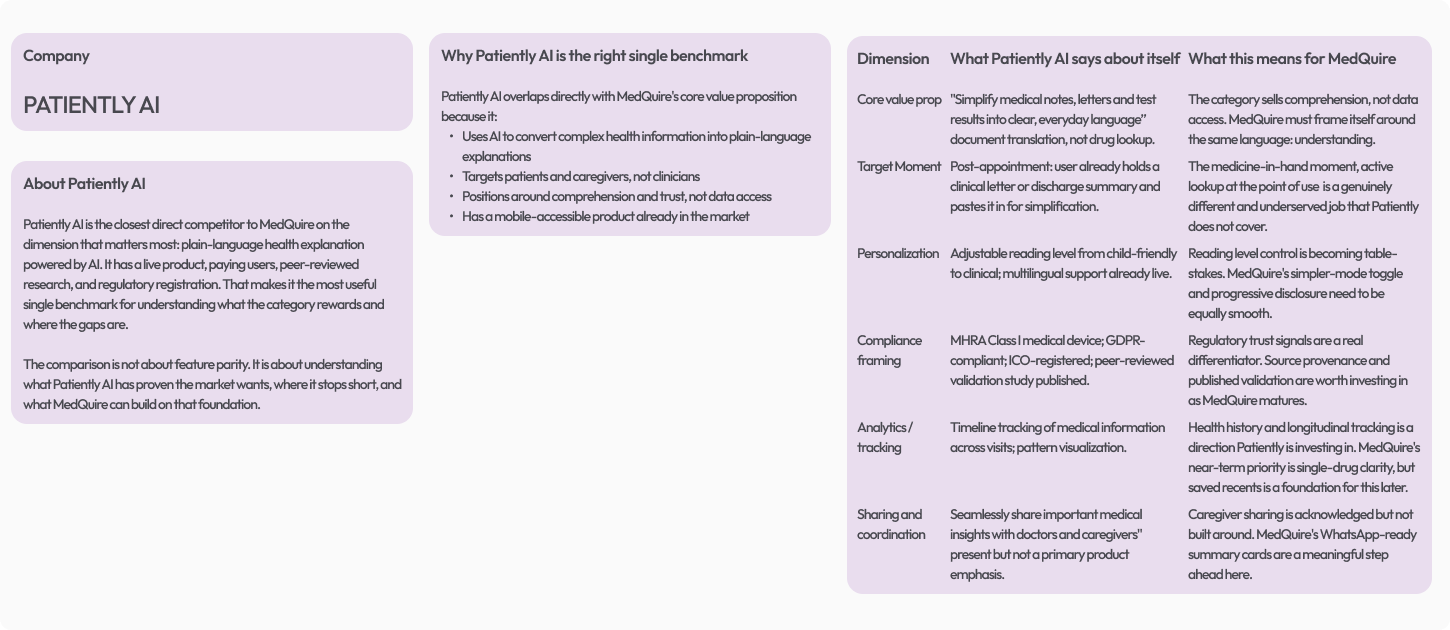
To better understand the market, we evaluated existing AI-powered healthcare applications.
One of the closest products we studied was Patiently AI, which uses artificial intelligence to simplify complex healthcare information and supports multiple languages.
While we appreciated its approach to improving healthcare accessibility, we identified an opportunity to build a product focused specifically on medication literacy.
What Patiently AI Does Well
- Simplifies medical information using AI.
- Makes healthcare information easier to understand.
- Supports multiple languages.
Opportunities We Identified
Rather than building a general health information assistant, we focused specifically on helping users understand and manage their medications.
This led to several product differentiators.
- ELI12 (Explain Like I'm 12) for an even simpler level of explanation.
- Drug Interaction Checker to help users better understand potential medication interactions.
- Exportable Medication Summary for easier sharing with caregivers and family members.
- Personal Medicine Cabinet for quick access to frequently used medications.
- AI Medication Assistant for asking follow-up questions in natural language.
- Auto Complete to help users find the correct medication easily.
These decisions positioned MedQuire as a medication-focused AI companion rather than a general healthcare assistant.
MVP Features
AI Medication Translator

The AI Medication Translator is the foundation of MedQuire.
Users can search for a medication or paste medication information and receive an explanation rewritten in clear, everyday language without changing the original meaning.
The objective is not to replace medical information but to make it more understandable.
AI Medication Assistant

The AI Medication Assistant allows users to ask follow-up questions in natural language.
Whether a user wants clarification about dosage instructions, side effects, precautions, or general medication information, the assistant provides a conversational experience that supports deeper understanding.
ELI12 (Explain Like I'm 12)

People have different literacy levels, educational backgrounds, and familiarity with medical terminology.
To address this, we introduced ELI12 (Explain Like I'm 12).
Rather than simply simplifying medication information, ELI12 rewrites explanations in language that an average 12-year-old can understand while preserving the original meaning and important safety information.
This feature became one of MedQuire's defining experiences.
Drug Interaction Checker

The Drug Interaction Checker allows users to compare medications and receive easy-to-understand explanations of potential interactions.
To improve accessibility even further, the same ELI12 experience was integrated into interaction results, ensuring users could understand not only that an interaction exists, but also why it matters.
Personal Medicine Cabinet

The Personal Medicine Cabinet provides a convenient space where users can save medications for future reference without repeating searches.
This creates a more personalized and practical experience.
Exportable Medication Summary

Medication information is often shared with caregivers and family members.
This feature generates a simplified medication summary that users can save or share when needed.
It supports better communication while making important medication information easier to access later.
Smart Medication Search (Auto complete)

As users begin typing, MedQuire provides intelligent autocomplete suggestions to help them quickly find the medication they are looking for.
This reduces typing effort, minimizes spelling-related search errors, and creates a faster, more intuitive search experience, particularly for medications with long or unfamiliar names.
Features Deferred
Not every idea belonged in the MVP.
One feature we intentionally postponed was:
OCR Prescription Scanning
The long-term vision included allowing users to scan prescriptions or medication packaging using their phone's camera.
The application would automatically extract medication information before generating simplified explanations.
Deferring this feature allowed us to deliver a more focused MVP while creating a clear roadmap for future development.
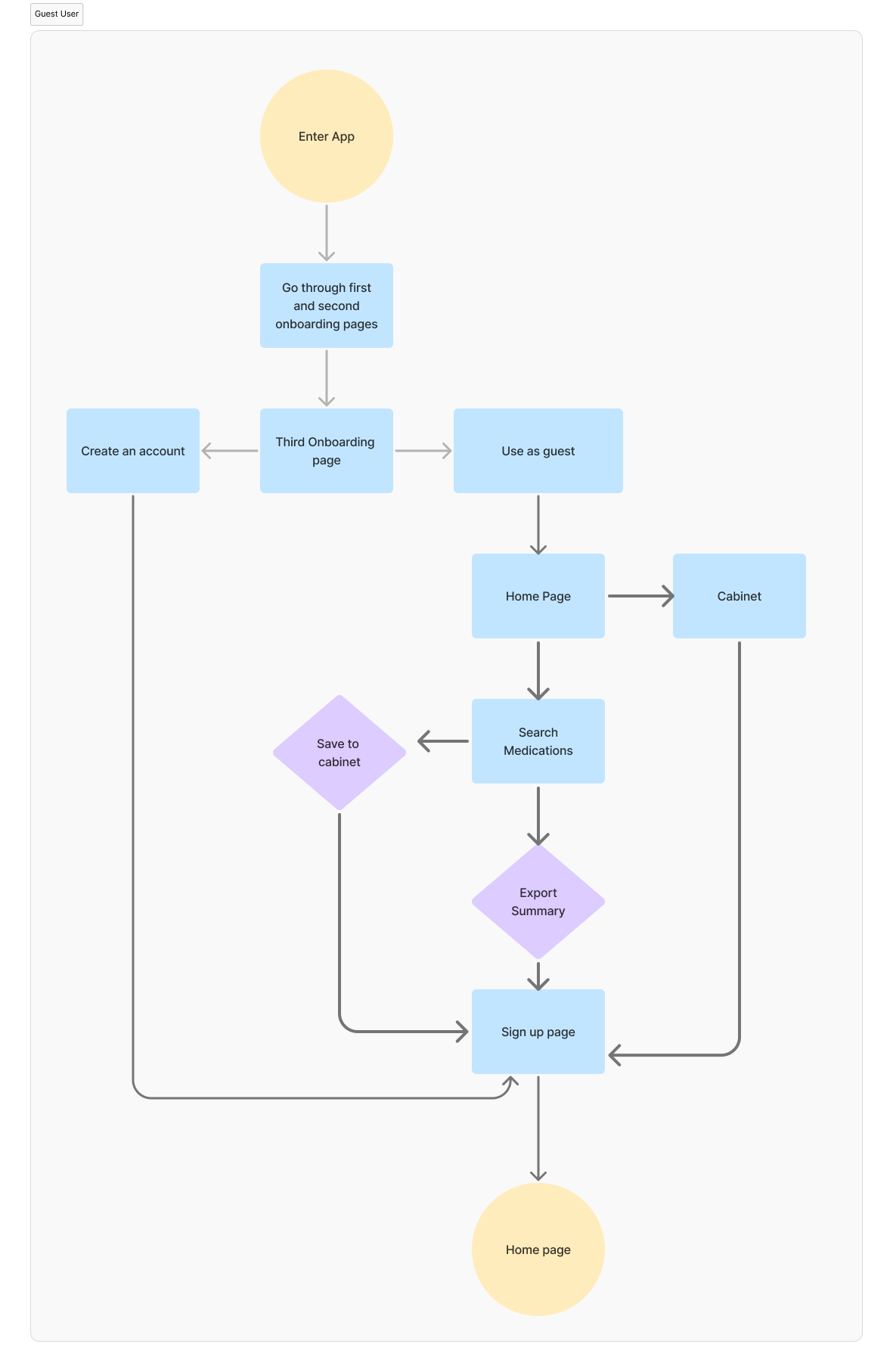
User Flow
Design System
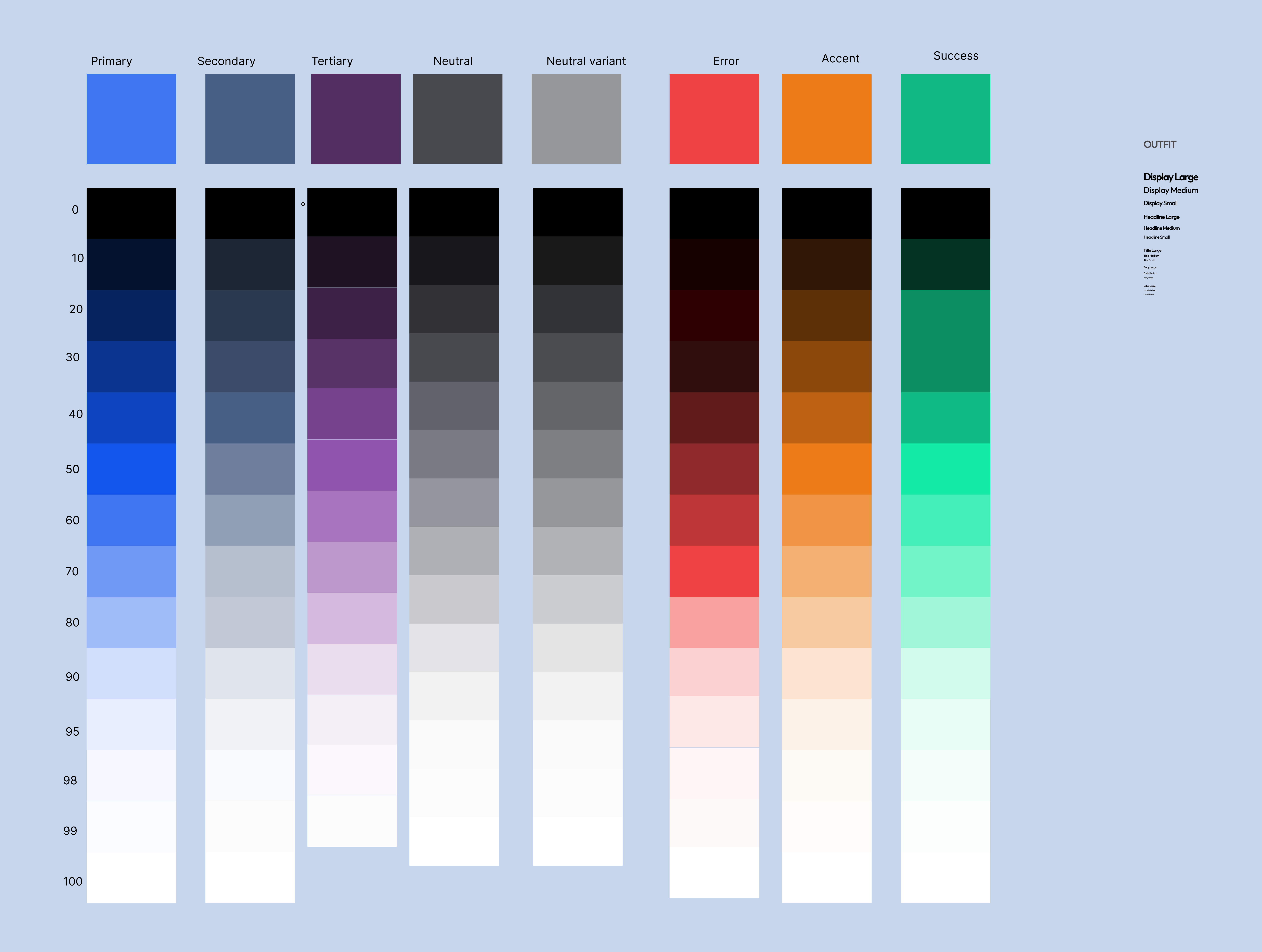
Consistency was an important consideration throughout the project.
The interface was built around a reusable design system that defined:
- Color palette.
- Typography.
- Components.
- Buttons.
- Form elements.
- Icons.
- Spacing.
- Layout patterns.
Maintaining consistency helped improve usability while making future expansion easier.
Challenges
Building MedQuire involved balancing user experience, technical feasibility, and the responsibility of presenting healthcare information accurately.
Throughout the project, we encountered several challenges that shaped both the product and our development process.
Selecting the Right Drug API
One of our earliest technical decisions was selecting a reliable source of medication data.
We evaluated several options before choosing the OpenFDA API because it provided comprehensive public drug information that aligned with the goals of our MVP.
Simplifying Without Losing Meaning
Perhaps the biggest product challenge was finding the balance between simplicity and accuracy.
The goal was never to rewrite medical information—it was to make it understandable without changing its meaning.
This challenge ultimately inspired one of MedQuire's strongest features: ELI12 (Explain Like I'm 12).
React Native Development
Developing the MVP with React Native and Expo presented several technical challenges during local development.
Managing dependencies, environment configuration, API integration, emulator testing, and debugging across different devices required far more iteration than we initially anticipated.
Although these issues occasionally slowed development, they strengthened our understanding of mobile application architecture, collaborative debugging, and problem-solving under real development constraints.
If I Continued Building MedQuire
Given additional time, I would focus on strengthening the product in two key areas.
Offline Support
Users should be able to access previously saved medications, explanations, and summaries even without an internet connection.
Usability Testing
While our research informed many design decisions, I would conduct multiple rounds of moderated usability testing with a wider range of users.
Observing real-world usage would uncover interaction patterns and usability issues that are difficult to identify during internal reviews.
Key Learnings
This project strengthened my ability to:
- Lead collaborative product design projects.
- Translate research into product decisions.
- Prioritize features using MVP thinking.
- Balance user needs with technical constraints.
- Design AI-assisted experiences responsibly.
- Collaborate across design and engineering.
MedQuire also deepened my appreciation for designing products in sensitive domains like healthcare, where every design decision has the potential to influence how people understand important information.
Closing Thoughts
MedQuire began as a bootcamp capstone project, but it evolved into something much more meaningful.
It taught me how to lead a multidisciplinary team, make thoughtful product decisions, and balance user needs with technical realities. More importantly, it reinforced my belief that technology is most valuable when it makes complex problems easier for people to understand.
MedQuire represents my approach to product design: start with empathy, validate through research, build with intention, and never lose sight of the people you're designing for.